
 Subscribe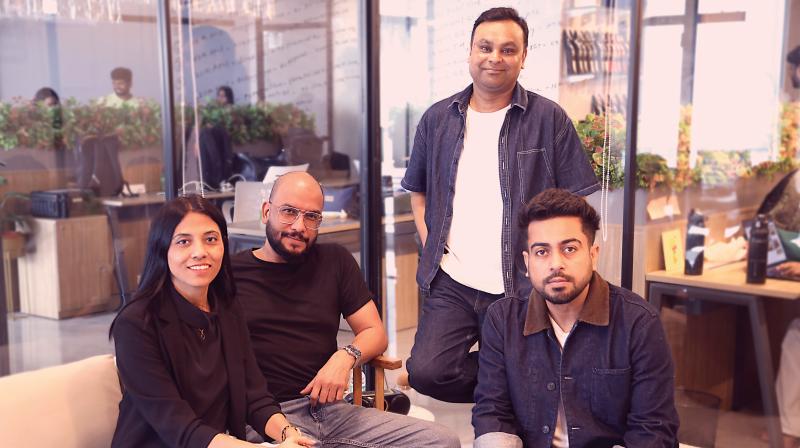
 (L to R) Khyati Sarang (planning head), Abheek Chatterji (chief of business) Abhik Santara (CEO), and Yash Kulshresth (CCO).
Two pressures shape brands today. The first is urgent - drive sales, clicks, conversions. Immediate and measurable. The second is enduring - build memory, preference and meaning. One gives you numbers. The other gives you a future.
Most brands and agencies, consciously or not, pick a side.
^ a t o m was built on a simple belief: you don’t get to choose. Every piece of work has to deliver on building the equity + deliver on short-term performance.
The only framework that matters
“We look at everything through one lens. What is driving short-term performance, and what is building long-term equity?," said Abhik Santara, Director & CEO.
Short-term performance is what gets you chosen today. It lives in feeds, formats, and fleeting moments. It is reactive, contextual, and often disposable by design. Long-term equity is what gets you remembered tomorrow. It lives in ideas, consistency, and distinctiveness. It compounds quietly, but powerfully.
Confuse the two, and you get brands that are loud but forgettable, or beautiful but ineffective.
Balance them well, and you get brands that not only work but last.
Why most agencies get this wrong
“There’s a familiar arc most agencies follow,” said Yash Kulshresth, Co-Founder & CCO. “They find something that works. A format, a tone, a style that gets rewarded. And then, slowly, almost invisibly, that becomes the thing they are known for.”
The emotional storytelling agency, digital-first shop, meme factory, humour side of things and the sports stars usage, etc.
It works for a while. Until it doesn’t. Consumers no longer behave in neat, predictable ways. They don’t move through funnels. They jump across touchpoints, platforms, and contexts.
A brand might meet them on Instagram, in a retail aisle, during a cricket match, or through a YouTube pre-roll. Sometimes all in the same day. Trying to solve that with a single format without keeping the behaviour of the medium in mind is not just limiting. It’s highly ineffective.
So what does ^ a t o m actually do?
Nothing complicated. Just the hard, often overlooked thing.
Start with the brand. Define what builds equity.
Identify what drives performance. And only then decide the format.
Not the other way around. Which is why the work, on the surface, looks deliberately varied.
There is a high-craft Limca TVC that builds freshness as a feeling, rooted in classic storytelling but executed with contemporary sharpness. It established the brand’s new vibe, feel, and positioning.
But enrolling Ananya Panday as Limca’s new Social Media Manager by placing her Limca ID card in public places got the social media audience talking. Same brand, same objective, different paths for different media.
Similarly, there is humour-driven work for AirAsia that cuts through clutter with wit and timing, in TVCs and performance-driven assets for its collaboration with an IPL team. Both talk about the same offerings, but respect the medium they use. Some of it is built to last. Some of it is built to move.
All of it knows which job it is doing.
For Stroom, we use AI to create hundreds of assets to drive product superiority, while also putting a film together to inculcate habit change.
Format follows intent
For a long time, agencies organised themselves around formats. TV, print, digital, social. Each has its own teams, biases, and ways of thinking. Today, those distinctions matter far less.
Consumers don’t experience brands in silos. They experience them in fragments that add up to a whole.
“It’s not about one format anymore,” said Kulshresth. “It’s about understanding where the brand needs to show up, and how it should behave when it does.”
Sometimes that answer is a large-scale film. Sometimes it is reactive content.
Sometimes it sits somewhere in between.
The goal is not to look consistent across formats.
The goal is to feel consistent across moments.
Craft as a non-negotiable
In its early years, like most young agencies, the focus was on momentum. Getting work out, building a portfolio, and earning trust.
But over time, that urgency has evolved into something more deliberate.
“Now we are far more conscious of what leaves the agency,” said Yash. “It has to meet a certain standard.”
Not in terms of scale or expense, but in thoughtfulness.
The way a frame is composed. The pacing of a story. The sharpness of a line. The restraint is not to overstate. In a world flooded with content, craft is often the only thing that earns attention and holds it.
Building teams that don’t stay in their lanes
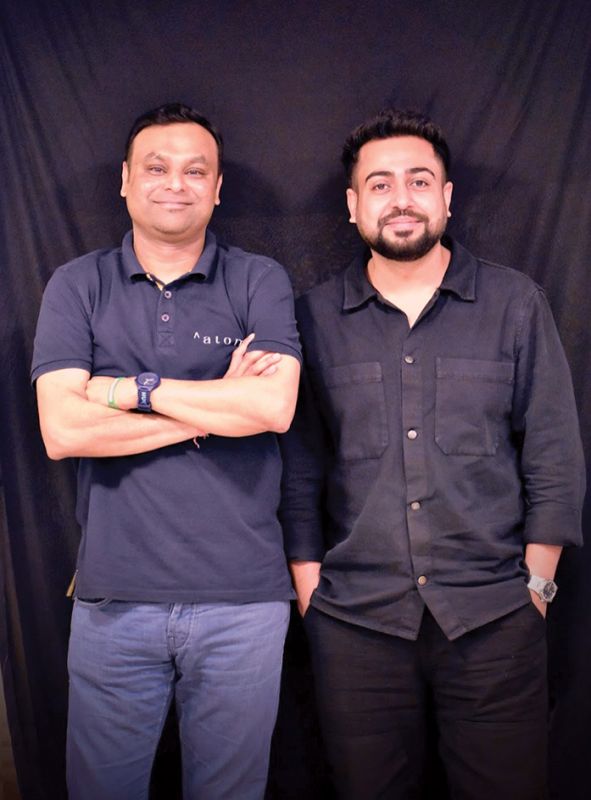
Abhik Santara (left) and Yash Kulshresth
Most agencies are built for specialisation. People get better at one thing and are encouraged to stay there.
It is efficient, but it can also be limiting.
^ a t o m takes a different view.
“If someone is great at writing films, most places will push them to do more of the same,” said Santara. “We encourage them to step out of that and explore other formats. In other words, we encourage people to fail. Success is easy to manage.”
The same applies across design and strategy. The idea is not to dilute expertise, but to expand perspective.
There is a certain bluntness to how Santara puts it: complacency is a dead person’s game.
It may sound harsh, but it reflects the reality of an industry that is constantly evolving. New tools, new platforms, new expectations.
Standing still is not neutral. It is regressive.
A roster shaped by thinking, not categories
This approach naturally reflects in the kind of brands the agency works with.
From beverages to BFSI, beauty to automobiles, textiles to infrastructure, the spread is wide. Not by design, but as an outcome of adaptability.
“Every category teaches you something,” said Kulshresth. “Each one sharpens a different muscle.”
Financial services demand clarity and simplification. Beauty requires nuance and aspiration. Automobiles demand scale and presence. Over time, these learnings cross-pollinate, resulting in work that avoids falling into predictable category conventions.
Beyond the broken funnel
For years, marketing was built around a clean, linear funnel. Awareness, consideration, purchase.
Today, that model feels increasingly outdated.
Consumers discover, evaluate, and act in unpredictable ways. They might encounter a brand digitally and purchase instantly, or discover it offline and engage with it later.
Every touchpoint carries weight. Some are designed to drive immediate action.
Others are meant to build memory and meaning.
The mistake is expecting one piece of communication to do both.
The opportunity lies in knowing which role each piece plays.
What brands can expect?
For brands, the promise is not a signature style or a fixed approach.
It is clarity of thinking.
An understanding of what needs to be performed in the short term, what needs to be built in the long term, and how to create both without one undermining the other.
“If you are looking to engage consumers across formats, but anchored to a singular brand story, that’s where we are best placed to deliver,” said Santara.
Six years in
Six years in, ^ a t o m is not trying to be the loudest agency in the room, or the most awarded, or the most talked about. It is trying to build something more enduring. Brands that people choose today.
And remember tomorrow. That balance is harder than picking a format. But it is also what makes the work matter.
Work by ^ a t o m
This article was first published in the May issue which can be bought here.