

 Subscribe
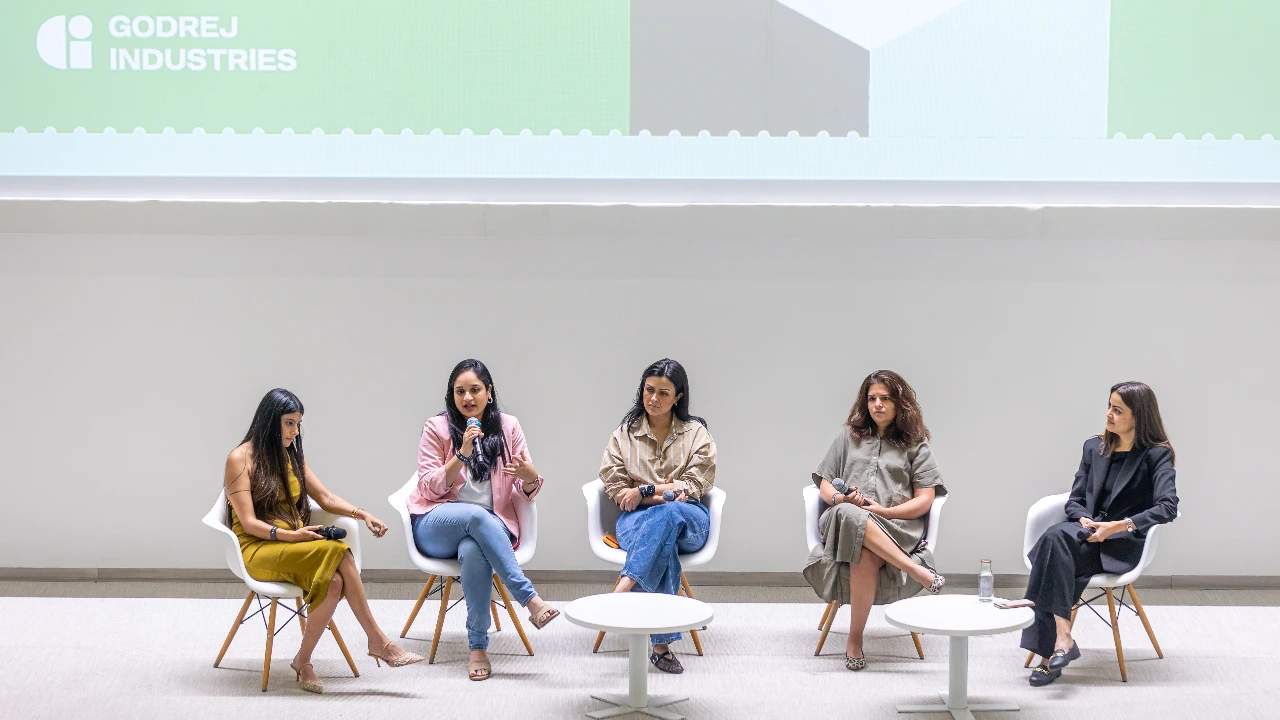
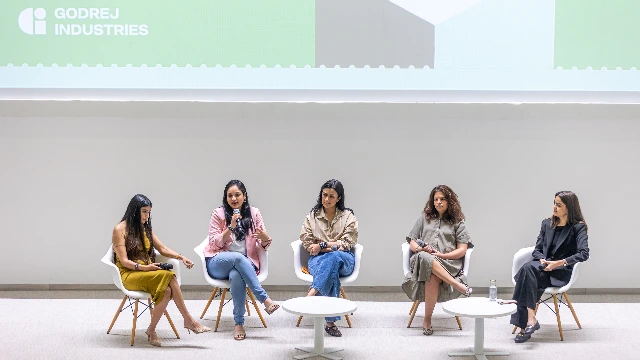
 From left: Pooja Manek, Aarthy Sridhar, Rashi Wadhera, Tara Kapur, and Guntas Randhawa
At the second Indian edition of Cannes Lions International Festival of Creativity's 'See It Be It Connects', organised by Indian Creative Women and Manifest in Mumbai on 19 November, a panel of female leaders discussed the challenges of navigating power, overcoming imposter syndrome and the psychological hurdles involved in leadership. The event was held in partnership with Godrej Industries, Adfactors PR, First December Films, Kulfi Collective, and Chrome Pictures.
Titled ‘The Politics of Being Powerful’, the panel featured Aarthy Sridhar, chief marketing officer, Gulf Oil India; Tara Kapur, director of marketing (global), DET, Duolingo; Rashi Wadhera, vice president, marketing communications, Nykaa; and Guntas Randhawa, chief marketing officer, health, South Asia, Reckitt. During the session moderated by Talented's Pooja Manek, the panellists shared personal experiences of their transition into leadership roles. The discussion also focused on the complexities of quantifying value and negotiating compensation as women professionals, overcoming gendered socialisation and advocating for fair financial compensation. The segment addressed the realities of organisational dynamics and the unique pressures faced by women in senior leadership roles.
On the first time one was put in a leadership position - did they feel ready for it, and how did they navigate the mindset challenge?
Guntas Randhawa: I would express immense gratitude to Unilever because it allows insanely big leadership opportunities very early in the career. The very first opportunity I took was leading sales for all of North India some 17 years back, and it was one of the most overwhelming stints I have had in my life. Imagine a 22-year-old who has a team of about 14 direct reportees and 200 consultants. The average age of the people reporting to me was about 45-55. One can imagine how insecure and timid I felt leading a team of people who had been doing this for more than 20 years. Over the years, I've had many more opportunities, and my biggest learning today is that I don't need to be the brightest spark in the room or the business. The best marketing idea on how to crack the sales number for the month doesn't have to come from me. My job is simply to create an environment that allows my team to come up with the best idea. I need to make choices, often unpopular ones, and ensure I remove the roadblocks from their paths so that they can run. Hence, for me, that has been the easiest mindset shift over the years. Every road you take must overwhelm you because that's the only way you will grow. Aur thodi fatthi hain toh achha hain, tabhi growth hoti hain! (Growth happens when there is fear)
On navigating gendered conditioning as a woman leader
Aarthy Sridhar: I had massive imposter syndrome, frankly. So, every time an opportunity came my way, at least in the early part of my career, I always felt like, ‘why does this person think I can do this?’ And I think fear was kind of the first response. I think that's very natural. But I was very lucky to have mentors and bosses around me at that time, who felt that I could do it. And, a lot of it in the initial part was about having to wing it. When I spoke later to people about it, they said, ‘We never realised it, as you always looked so confident.’ So, clearly, I was winging it some of the time. Over time and with experience, one learns. And one of the biggest things I have also had to learn is that, as a girl, I think we're very confused when we're growing up. We're told that people need to like you, and that thing about making people like you is always somewhere there. I think it dictates how one behaves in a lot of ways. One of the biggest things I had to unlearn is that it's okay if people don't like you. Nowadays, that's not the first thing I go for. That's a big mindset change I've had to make as a leader. When ones make a decision, it's going to be liked by some and not by some.
Frankly, it's just a little bit more about being self-aware. I go back to something one of my male bosses said to me very early on: ‘You just need to have the confidence of an average man.’ Even today, when I sit in meetings and somebody is speaking very confidently, sometimes what they're saying is not right, and I know it. They're being super confident, and I think that even when I know my stuff 100%, I'm still not as confident as them. So, it's a process, and you need to keep reminding yourself of it.
Tara Kapur: Own the space that you have. That's the hard part but I feel like it's something that we need to do as women. You do the work, you get the position, you get the space, but you need to own it, and you need to be more assertive than anyone else because no one is going to give you that title or respect unless you grab it. As women, we tend to overthink a lot, and we analyse. We're like, we have to be absolutely ready for the promotion. We are our own worst enemies. Sometimes, we question, and we always think this is going to come across as harsh. This is going to be something that's tough to say. But I realised that we filter ourselves in the best way. So, don't listen to the rest of the noise. Do what your intuition, what your feelings are telling you, and that's 99% the right way to do it. According to a performance statistic, most men ship something when it's 70% ready. Women ship it when it's 90% or 95% ready. But the issue is that when you wait for it to get to 95%, you might be late or running behind on a timeline. I've tried to learn that, but what I do is ship it when it's 80%, so it is still better than what the guys might do in the room. But it's about getting it out of the planning space in other ways. Those are some of the things I've learned along the way.
On being self-aware in a leadership role
Rashi Wadhera: My experience is actually deeply personal. I was a professional dancer when I was 12. Looking back, I think growing up, this dynamic of performing or being this prima donna, always being centre stage, skewed my dynamics and understanding. I was 25 when I became editor of Little Black Book, which has since been acquired by Nykaa. And I was always ‘I'm the star of the show, and I'm the best.’ This is so detrimental to you as a leader and to your team. I almost viewed my team as competition, which, again, in retrospect, now that I am much older, I realise was wrong. Now, I will not go anywhere if I don't take my people along with me. Their success is my success, and if I view them as competition, the only person who will lose is me. I have since realised this, but I had to consciously break that thinking through therapy and by getting a corporate coach at some point. As I got older, this idea of performance really stayed with me. I think I realised that there are right ways and right scenarios to perform, and there's a right time to take the spotlight and a right time to push your team into that spotlight. That's how I discovered a lot of my leadership tendencies over the last few years.
On undertaking uncomfortable salary negotiations
Rashi Wadhera: I have realised that, growing up as a woman in a Punjabi household, my relationship with money and finances was almost infantilised. My father was always like, ‘I'll take care of it. I'll do your investments,’ and I was okay with it. As a consequence, I was like, ‘I don't know how to quantify what I bring to the table, and I don't know how to quantify my value.’ My advice to all the girls on my team who are 23-24 and come to me during appraisals saying, ‘I think I should make this much’, is to understand how they have arrived at that figure. My sincere recommendation is to understand finances, not just for your own independence, but also because you have to find metrics to quantify your value. It is scientific. You have to benchmark against peers. You have to benchmark against education. You have to benchmark against how your organisation operates. A lot of organisations discourage one from asking peers about their salaries. So, if you develop a better relationship with finances early on, you know how to quantify your value, and that really helps negotiations because, at a point, if you approach the conversation with data, it's infinitely tougher for the person across from you to say no.
Guntas Randhawa: So, I recently switched jobs. For the longest time, I never negotiated my salary. Never, not for 17 years. I was such a f***ing fool. I just wanted to do great work, and I used to derive so much joy from my work that, for me, value wasn't the driving force. And one more thing, which I refused to admit to myself for the longest time, was that I felt like a cheat for putting a value on what I bring to the table. It was like, ‘Main bhaji thodi khareed rahi hun’ (I'm not buying vegetables), to negotiate an X per cent bonus or Y per cent increment. So, for the longest time, I was shy about doing it. But this time around, when I was switching roles, I made three very big changes. So, we don't discuss salaries with each other, right? I changed that about three years back. I started asking my peers about their CTC, increment and bonus. Guys do it all the time. We don't. It is a gender thing. And when you have close friends, they will share it with you, and you will realise how underpaid you are. Once I started seeing the salary slips, I was so angry because I was very confident about the value I bring to the table. For the same work that we do and the same hours that we spend, we deserve the same amount of money, if not more.
I used to always feel that my work will speak for itself. Big mistake. Don’t ever think your work will speak for itself. Also, over time I’ve come to accept that ambition is not a personality flaw that needs to be fixed. So what I've done to get out of this mode of, ‘Am I too cheap? How can you put a value on me? I am invaluable’ is I started putting a value on the mandate being given to me. I'm not saying this is what I deserve. But the role I was competing for had people with at least six to eight years more experience competing for it. I know the worth of the mandate being presented to me, and the value I will create. So, I went and negotiated for the mandate, not for me. These big shifts in my mindset really helped me.
Tara Kapur: I love that all of us sitting here had such similar experiences of how tough it is to negotiate. And I feel like that's something everyone faces in this room. For me, the hard part is that sometimes you have to be willing to take the risk and say, ‘If you don't want to pay me what I'm worth, I will go elsewhere.’ And I'm not saying it as an empty threat, but I think it's really about putting a figure to what you see as your value or worth for that role, and asking yourself whether you can find that elsewhere. When I came to know that there were people on my team making double what I was making, I shifted teams, and there was still no correction. So, I went out and found another job that was actually paying me significantly more. And my salary changed overnight because they did not want to lose me, and I didn't actually want to leave. But I was ready to leave. The point was that I had a figure in hand. There was no question asked as soon as that offer was on the table, But it's tough to get there. I had to do a lot of interviews to get that offer and throw it in their face. But the rage is great sometimes when it comes to negotiating. Yes, you need to benchmark, but you need to know what's the right value for yourself. We all benchmark differently. We've all had different journeys as we've progressed in our careers. Your competition is with your own benchmark and your own salary, and what makes you happy. It's not just about the figure itself. Yes, there's value that comes with it, and you need to be paid for your work, but you also need to think about all the other factors in your life. Because, as women, we're carrying way more of the load, and you need to balance all of that to make your career more sustainable. This is something you're going to be doing for a very long period of your life, so it can't just be about leaving one job and going to another toxic one because they're paying X% more than your previous salary.
Jack Daniel's Merchandise was the 'Experience Partner' for the event.
Catch updates from See It Be It Connects through the week on Manifest.
Also read:
See It Be It Connects 2026: 'We're not here to win an election or a popularity contest'