
 Subscribe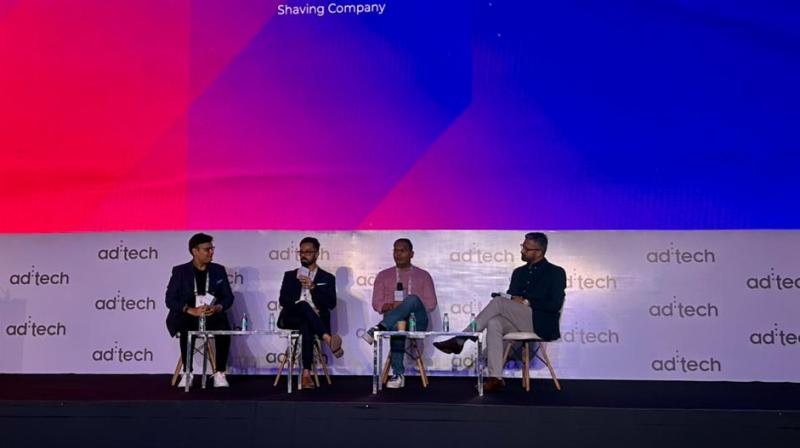
 Left to right: Siddharth Jhawar, Abhishek Shetty, Deepak Gupta and Pratik V Udeshi.
On the first day of ad:tech 2026, conversations weren’t limited to AI and creativity. They extended into one of India’s fastest evolving consumer behaviours: quick commerce.
A panel brought together platform leaders and a brand to unpack how the category is evolving beyond its early promise of speed.
Moderated by Siddharth Jhawar, country manager, Moloco, the panel featured Deepak Gupta, co-founder and chief operating officer, Bombay Shaving Company; Abhishek Shetty, marketing head, Instamart; and Pratik V Udeshi, head of LCS – CPG, beauty, and Amazon Now, Amazon Ads.
Kicking off the discussion, Shetty set the tone by reframing how the industry should think about growth. “I still believe quick commerce is early in its S-curve,” he said. “The last few years have seen phenomenal growth, largely driven by the promise of 10-minute delivery, and consumers have really lapped that up in a big way.”
But that phase, Shetty argued, is already maturing.
“The next wave of growth is not going to come from faster delivery,” Shetty expressed. “Ten minutes is now just the cost of entry. It’s no longer a differentiator.”
Instead, the next set of users will be driven by deeper value.
“The consumers who will come in next are looking for relevance, consistency and better assortment,” Shetty explained. “That’s where the real expansion is going to happen.”
He also pointed to a more fundamental shift in behaviour.
“What will really change is how people shop,” he said. “Quick commerce will move from being a convenience layer to becoming a primary shopping platform. That’s where the real transformation lies.”
For brands, this shift requires a rethink of how quick commerce is positioned within their overall strategy.
Gupta was clear that the framing itself needs to evolve.
“Over time, we’ve stopped looking at quick commerce as just another channel,” he stated. “We now see it as a feature, a fundamental capability that will exist across platforms.”
As consumer expectations shift, speed becomes table stakes across the ecosystem.
“Consumers expect faster delivery everywhere now,” Gupta expressed. “Whether it’s marketplaces or even your own brand website, everyone will be forced to adapt.”
For newer brands, this shift presents an opportunity noted Gupta. He shared, “As a young brand, this actually works in our favour. Our ability to innovate quickly and reach new consumers is much higher compared to traditional brands.”
He also pointed to the pace of growth the category continues to deliver.
“I see quick commerce continuing to expand rapidly,” Gupta added. “For us, it’s not just incremental, but it’s becoming a significant driver of growth.”
From weekly baskets to daily micro-moments
Udeshi added another layer to the discussion, framing quick commerce as a behavioural shift rather than just a supply chain innovation. “At its core, this is about habit formation. The way consumers shop has fundamentally changed,” he said.
Udeshi described how traditional patterns are being replaced. “What used to be a weekly supermarket trip is now being broken down into daily micro-moments,” he explained. “Consumers are no longer planning for the week; they’re fulfilling needs in real time.”
Udeshi also pointed out that this shift has broader implications for brands.
“A brand does not need the same kind of deep offline distribution anymore,” he said. “The entire model is evolving.”
And despite the rapid growth, Udeshi believes the category is still at an early stage. “We’ve seen strong momentum over the last few years,” he added. “But from our perspective, this is still day one.”
DTC vs quick commerce
As quick commerce grows, questions around budget allocation and channel strategy naturally follow.
Gupta was clear that direct-to-consumer (DTC) platforms still play a distinct role.
“Our own website continues to be critical for us,” Gupta shared. “It’s where we have control, access to first-party data and the ability to build deeper brand relationships.”
That role hasn’t changed, but quick commerce has introduced a new layer of efficiency.
“What quick commerce has done is allow us to monetise demand much more effectively,” Gupta explained. “Earlier, you had long cycles through general trade, with heavy investments in top-of-funnel marketing.”
Now, the journey is more compressed.
“You can build demand through DTC and capture it instantly through quick commerce,” he said. “That’s a significant shift.”
While budgets are evolving, they are not being replaced entirely.
“There is some shift from marketplaces to quick commerce,” Gupta noted. “But each platform still serves a different purpose.”
Why speed alone cannot build loyalty
When asked if speed drove adoption, what drives loyalty? Shetty had a clear-cut answer: consistency over speed.
“Ten-minute delivery was never defensible,” Shetty said. “Any player can replicate that.”
Instead, the real challenge lies in execution.
“If I have to deliver milk across thousands of dark stores every single day, fresh and high quality, that’s where the real difficulty lies,” he expressed. “Consistency is what builds trust.”
He emphasised that a slightly slower but reliable experience often wins.
“A wrong 10-minute delivery is far worse than a correct 12-minute delivery,” he said. “That’s the trade-off brands need to understand.”
Personalisation and the power of data-led moments
Beyond consistency, relevance plays a critical role in building loyalty.
“With quick commerce, you’re sitting on a massive amount of data,” Shetty said. “The question is how you use that data to personalise experiences.”
Shetty illustrated this with a simple but powerful example.
“Through search behaviour, we can identify life-stage changes,” he said. “If someone moves from searching for cold drinks to diapers, there’s a strong signal that they’ve become a parent.”
Acting on that insight can create meaningful connections.
“If you can respond to that moment with something thoughtful, the impact is far greater than any ad campaign,” Shetty said. “That’s how real loyalty is built.”
The rise of intent-driven marketing
Udeshi expanded on this idea, positioning quick commerce as one of the highest-intent environments available to marketers.
“This is not just a logistics play,” he said. “This is a moment of extremely high intent.”
Unlike other platforms, attention here is focused, Udeshi went on to explain. He said, "If a consumer wants something in 10 or 15 minutes, they’re not going to spend 45 minutes browsing. That compressed window of attention is incredibly valuable.”
For brands, this changes how marketing should be approached.
“You need to maximise your presence in these micro-moments,” he advised. “That’s where the real opportunity lies.”
Balancing monetisation with user experience
As platforms explore monetisation, maintaining user experience becomes critical.
Shetty acknowledged the delicate balance. “Every ad you see doesn’t need to be intrusive,” he said. “It needs to be contextual and add value to the shopping experience.”
The focus, Shetty explained, is on enhancing, not interrupting, the journey.
“If a user comes in to buy milk, can we recommend something complementary that increases their basket size?” he voiced. “Or are we slowing them down unnecessarily?”
Maintaining that balance requires constant monitoring.
“We track the entire journey very closely,” Shetty stated. “There are guardrails to ensure that organic discovery isn’t compromised.”
Quick commerce platforms are far from uniform
Gupta highlighted how each platform brings distinct strengths. “Each platform has its own nuance,” he said. “You can’t treat them all the same. Some excel at discovery, others at repeat purchases or specific demographics."
“Certain platforms are stronger in premiumisation and discovery,” Gupta added. “Others are better for basket building or attracting younger audiences.”
This diversity requires tailored strategies, Gupta shared. “You need to think about assortment, pricing and even city-level differences. One size does not fit all," he expressed.
From attention to intention-led ecosystems
Udeshi urged brands to take a broader view of consumer behaviour.
“Don’t think of quick commerce as just a moment of fulfilment,” he stated. “Think about how consumers engage with you across the entire day or week.”
That longer view is critical.
“If you only focus on that short window, it’s very hard to influence behaviour,” Udeshi said. “You need to be part of the consideration set much earlier.”
Retail media, Udeshi added, plays a key role in bridging that gap.
“It allows you to build engagement before the purchase moment and then drive conversion,” he said. “That’s where the full funnel comes into play.”
Shetty outlined what brands need to prioritise to win in quick commerce. “The first big shift is solving for impulse,” he said. “You need to rethink packaging, pricing and SKU sizes specifically for this environment.”
Shetty also pointed to the importance of cultural relevance. “India is driven by occasions, festivals, celebrations, and everyday moments,” he remarked. “How do you show up meaningfully in those moments?”
Finally, Shetty emphasised the role of experimentation.
“The feedback loop in quick commerce is much shorter,” he said. “That allows brands to test, learn and iterate much faster.”
Gupta, in his final remarks, shared that the momentum for quick commerce has built up, and it is now about capitalising on it.
And Shetty, wrapping up, said, “A successful quick commerce platform is not just about delivering faster. It’s about delivering better, more relevant and more meaningful experiences.”