
 Subscribe
 Laurent Thevenet
As agencies rethink the intersection of creativity and technology, the ‘creative technologist’ role is moving to the centre. For Laurent Thevenet, head - creative technology, Publicis Groupe, APAC, that shift has been years in the making, shaped by a career spanning engineering, independent practice, and global agency networks.
During a chat with Manifest, at ad:tech 2026 in New Delhi, Thevenet framed AI as foundational rather than differentiating, arguing that the real challenge lies in how organisations structure their use, balancing speed with control and experimentation with governance. On the sidelines of the summit, he spoke about navigating AI-driven innovation within these guardrails, the evolving role of creative technologists, and why human judgment continues to define the final output.
Thevenet’s career arc explains why he sees creative technology as less of a niche and more of a connective tissue inside agencies today.
He shared with us, “My career spans around 25 years, and I didn’t even start in advertising. I was an engineer before moving into agencies, and eventually into running my own studio. That journey meant I was always working across disciplines, which is essentially what creative technology is about. Back then, the role existed but didn’t carry the weight it does now. You had to constantly prove its value through output. Today, while I wouldn’t say it’s the most important role, it’s essential because the industry now needs people who can bridge technology and creativity seamlessly.”
What he’s really pointing to is a structural shift. Creative technologists are no longer support functions; they’re central to how ideas are built, scaled, and delivered across increasingly complex ecosystems.
When it comes to AI adoption, Thevenet makes a strong case for nuance over uniformity.
“At a company of our scale, with around 100,000 people globally, you can’t apply a one-size-fits-all approach to AI. Different teams, markets, and clients require different speeds of innovation. Some people are already building with AI in highly experimental ways, while others are still learning the basics. My role is to create a system that accommodates all of that, where governance provides structure but doesn’t stifle progress. Too much governance slows you down, but too much freedom creates chaos. The balance lies in creating controlled environments where innovation can happen and then scaling what works," Thevenet expressed.
In practice, this means constantly testing tools, building internal frameworks, and thinking in systems rather than silos. What this really means is that AI adoption inside large networks is less about the tools themselves and more about designing how those tools are used.
On the ground, AI is already reshaping how creative teams operate, even if the end output still looks familiar.
He stated, “The biggest change is in the process. We’re prototyping much more, and creatives are even building their own AI-powered tools tailored to specific clients or workflows. These aren’t always scalable solutions, but they’re incredibly effective in context. The final output hasn’t fundamentally changed; great work is still great work, but the path to getting there is faster, more iterative, and often more ambitious. At the same time, teams themselves are evolving. You now have creatives working alongside engineers, data scientists, and people from completely different backgrounds. There’s also far more openness; earlier, ideas from technologists could be judged harshly, but now there’s genuine collaboration.”
This shift is as much cultural as it is technological. It signals a move toward hybrid teams where boundaries between roles are increasingly fluid.
On consolidation, Thevenet is clear that AI isn’t the differentiator many think it is. He added, “AI today is like water or electricity; it’s everywhere, and everyone is using it across functions, whether in creative, media, or operations. The real difference comes from how you use it. For us, that means leveraging proprietary data, maintaining high standards, and ensuring safety and security. Ultimately, AI supports the process, but the thinking, the judgment, and the creative decisions still come from people.”
That idea carries through into execution, particularly in complex campaigns like AXA’s ‘Bucket List’.
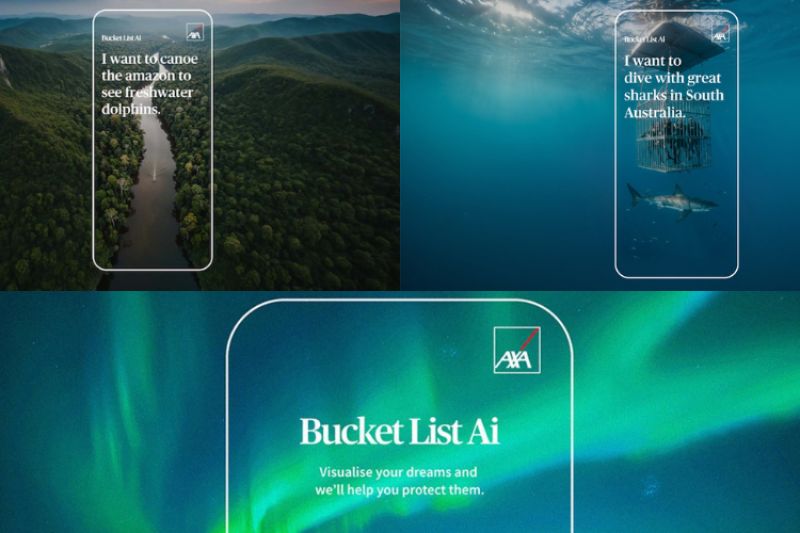
Talking about the campaign, Thevenet shared, “Working with a highly regulated brand meant we couldn’t rely on open systems. We built a secure, end-to-end pipeline using approved tools and collaborated across markets like Japan, France, and Australia. The scale was massive. We generated around 10,000 images mapped to different user inputs. But the real breakthrough was making it feel instant. Instead of generating images in real time, we pre-built a structured system that could deliver personalised results immediately. It was about combining speed, safety, and relevance without compromising on any of them.”
It’s a clear example of how AI-led creativity is as much about engineering and infrastructure as it is about ideas.
For younger talent entering the industry, Thevenet sees both an advantage and a responsibility.
“Young creatives already come in with a very different mindset because they’ve grown up with digital tools. They’re naturally more experimental and often approach problems like hackers. Over time, I don’t think creative technology will remain a separate discipline; it will become a baseline expectation. Everyone will need to think creatively and systematically. What’s equally important is bringing your full self to work, not just your core skillset but your interests, side projects, and perspectives. That’s what creates real differentiation," he remarked.
And finally, on AI itself, he believes the industry may still be underestimating its capabilities. Thevenet sounded, “Creatives sometimes underestimate how powerful these systems have become. Earlier, it took multiple iterations to get something usable. Now, even a single prompt can deliver strong results. Taste still matters, but the machine is raising the baseline. In some cases, it can even surpass our existing standards, which means the real challenge is pushing ourselves to think at a higher level and refine our judgment.”
That’s the tension he keeps coming back to: AI may be everywhere, but the real edge lies in how thoughtfully it’s used.
Read the full interview in the April issue of Manifest, which can be purchased here.
Also read:
India is leading in AI experimentation, now comes the hard part - scaling results: Adam Goodman