


 Subscribe
 Image by IADE-Michoko from Pixabay
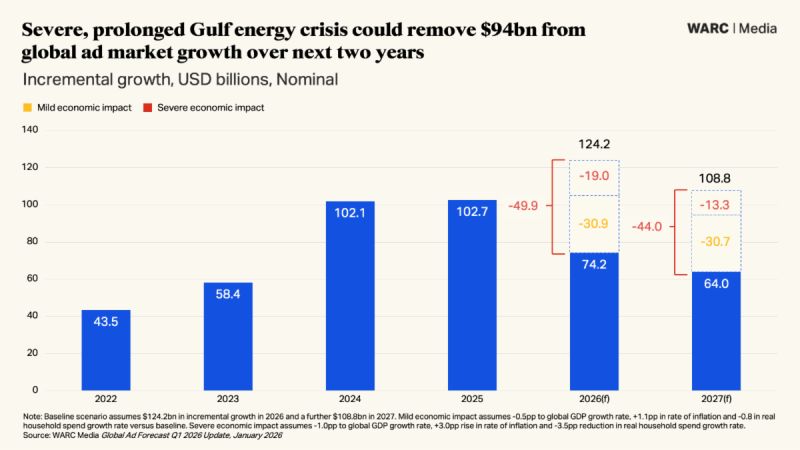
A report from Warc revealed that a prolonged war in the Middle East could cause advertising spend to dip by close to USD 50 billion this year, and by USD 93.9 billion by the end of 2027.
Even if the war doesn't prolong, advertising spending is expected to dip this year by USD 19 billion with 'residual impacts' lasting for a year.
Warc has revealed studies for three scenarios:
Scenario A: Short-lived, contained shock; temporary oil spike, Hormuz disruption avoided
Warc’s baseline scenario projects 10.4% ad market growth in 2026 to a total USD 1.3 trillion. This scenario assumes an oil price holding around USD 100 per barrel for up to six months, before normalising in the fourth quarter. In this scenario, the product categories identified as being most susceptible to the shock – automotive (+6.8%), food (+10.3%), leisure & entertainment (+11.4%) and technology & electronics (+13.7%) – are mostly expected to record ad spend growth in line with the global rate. The outlier is travel & transport, where spend is set to fall by 3.5% – equivalent to a net cut of USD 1.3b billion. This is based on global airlines and tourism firms active in the Middle East already holding back media budgets, and while these may be reallocated later in the year, high fuel prices and a squeeze on family incomes present serious headwinds for the sector.
Scenario B: An extended shock; oil elevated for a year to threee years, partial supply disruption
Cuts ad market growth equivalent to UDS 19 billiond dollars in 2026 and a further USD 13.3 billion in 2027.
According to the study, this is consistent with economic and advertising trends recorded during the 1991 Gulf War. It assumes an oil price above USD 100 per barrel sustains over the two-year forecast period, resulting in monetary tightening by central banks in a bid to combat stagflation.
This scenario presents a greater risk to the advertising and media industry, as consumer purchasing power is limited and businesses act to protect margins in a challenging trading environment.
Scenario C: A severe, systemic shock; prolonged closure of Strait of Hormuz, oil reaching USD 150 per barrel
A prolonged Gulf crisis removes USD 93.9 billion from ad market growth over the next two years. Warc links this to the 1973 oil crisis which results in aggressive monetary tightening across key markets as central banks attempt to prevent mounting recessionary risks.
A result of this is consumer confidence collapsing, and real household spend falling year-on-year. The result of this is ad spend growth is either flat – food (+0.7%), leisure & entertainment (+0.2%) – or falling; travel & transport could cut budgets by 5.8%.
Taken together, the global ad market would still grow 6.2% this year.
James McDonald, director - data, intelligence and forecasting, Warc, and author of the research, said, “Even in a contained scenario, an oil shock of this nature acts like a tax on consumers – pushing up prices while eroding real spending power. In a more prolonged or severe disruption, we move into stagflation territory, where sectors like travel, automotive, food and consumer electronics take a direct hit from both rising costs and falling demand. The net effect is a meaningful squeeze on discretionary spend that puts up to USD 50 billion of anticipated ad market growth at risk this year, as brands pare back their media investment in a bid to preserve thinning margins.”
Social media trends update
Working with Omdia, Warc Media has also published quarterly, category-level ad spend data for eight social media platforms – Facebook, Instagram, LinkedIn, Pinterest, Reddit, Snap, TikTok, and X – across 20 key markets.
Meta's annual ad revenue forecast projects Instagram will grow by 26.9% to reach USD 101.6 billion and Facebook will reach USD 137.8 billion (19.2% growth). In 2027, it anticipates more measured gains in 2027, with Instagram’s year-on-year growth slipping below 20% for the first time (+15.5%) and Facebook returning to single-digit gains (+9.6%).
TikTok is forecast to maintain global ad spend growth in excess of 20% over the next two years, The total revenue is expected to reach USD 43.1 billion next year.
Reddit’s global ad business is set to double from USD 2.1 billion in 2025 to USD 4.1 billion in 2027. The US accounts for more than three-quarters of that revenue.
After four consecutive years of ad revenue decline following the acquisition by Elon Musk, X’s ad business finally returned to growth in 2025 – rising 1.6% to USD 1.8 billion. The platform’s ad revenue is set to grow to nearly USD 2.0 billion in 2027. This is short of the USD 4.5 billion earned by Twitter in 2021, with many brands still having concerns about brand suitability – compounded by use of its Grok AI tool to non-consensually alter images of individuals, including children.