
 Subscribe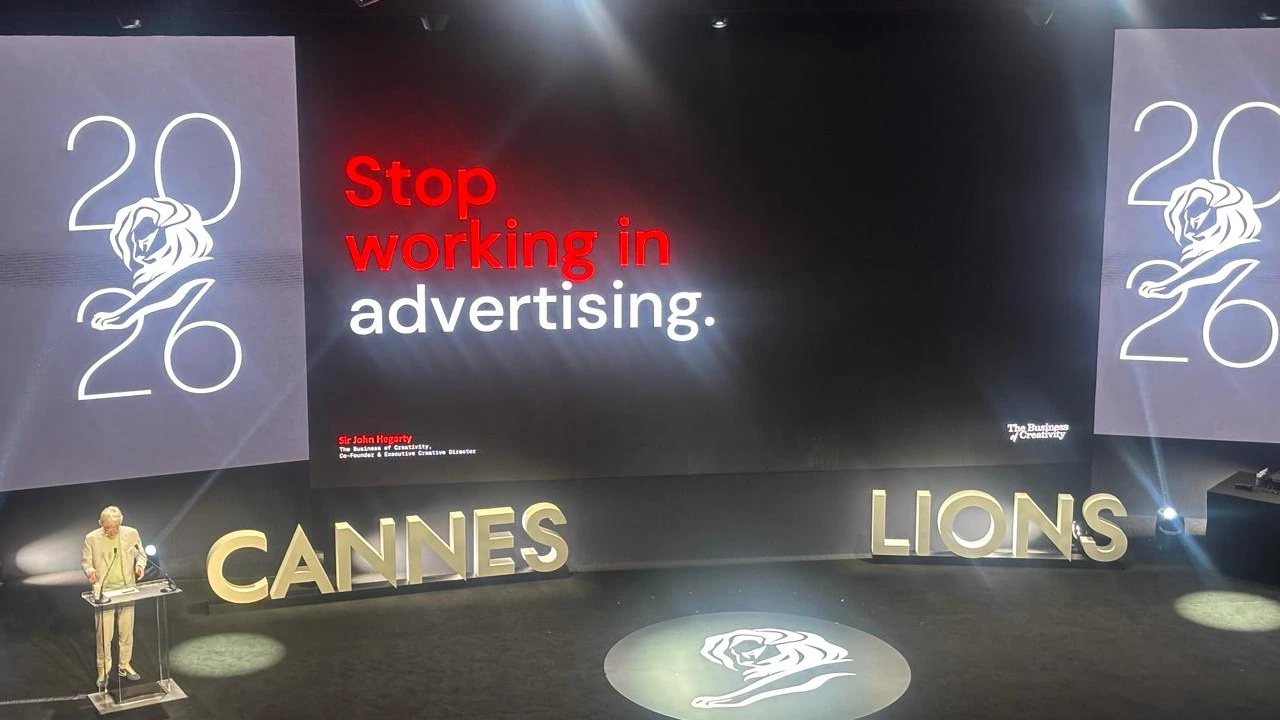
 Sir John Hegarty
Few people can command a Cannes Lions audience quite like Sir John Hegarty.
The co-founder of BBH, recipient of Cannes Lions’ inaugural Lion of St Mark award, and one of advertising’s most influential creative thinkers, took to the stage on day four with a message that was equal parts diagnosis, warning and rallying cry.
His core message was simple yet unsettling: advertising has forgotten what made it powerful in the first place – the art of storytelling and persuasion.
Hegarty contended that the industry’s obsession with targeting, tracking and optimisation over the last many years has come at a profound cost.
“We’ve perfected the art of stalking rather than inspiring. And in most countries stalking is illegal. Actually, if you’re a brand stalking people, then you should be very, very careful,” he remarked, drawing laughter from the audience, but the point was made.
According to Hegarty, advertising’s increasing reliance on data and algorithms has resulted in a product consumers actively seek to avoid.
“People are paying good money to avoid advertising. In reality, we are making a worse product. There’s no question about that. All research points to it. People are disillusioned with advertising, they don’t like it.”
He continued chastising the industry with characteristic bluntness: “I’ve never read a business book that says, ‘To succeed, make a worse product.’ But that’s what we’re doing. We’re making a worse product. And no wonder people are turning off. They’re not turning off Netflix. They’re not turning off the World Cup. They’re turning off the things they don’t love. And sadly, they’ve fallen out of love with us.”
This decline extends beyond advertising itself, according to him. He believes the industry’s fixation on short-term promotional tactics has weakened brands and even hindered economic growth.
“Because of our focus on promotion rather than persuasion, advertising isn’t creating the change that it needs in society.
Advertising is a fundamental part of an economy. It drives growth, it drives creation of ideas, it drives creation of brands. And what we’ve seen over the last 20 or 25 years is a lack of growth. I genuinely believe part of that is because we have focused on promotion as opposed to persuasion.”
At the heart of his argument was a reminder of advertising’s original purpose: building enduring brands.
“A brand is the most valuable piece of real estate in the world. It’s a corner of someone’s mind. You’re trying to become a part of their world. You’re trying to elevate your brand into culture,” he reminded the listeners.
If advertising is struggling for attention, Hegarty argued, the industry should look closely at who is winning that battle. The answer, unsurprisingly, is entertainment. The lesson, he said, is not simply to entertain for entertainment’s sake, but to understand how storytelling transforms engagement.
Pointing to recent OTT series such as Adolescence, and other acclaimed programmes that turned complex social issues into national conversations, Hegarty argued that entertainment succeeds because it knows how to make people care.
“The entertainment industry has understood that to engage, you need to entertain. They understand how to engage when it’s a subject matter that you don’t necessarily want to engage with. That’s the great lesson we can learn.”
For advertising, the implications are obvious, he stated. “Advertising has got the answers. It’s storytelling. Storytelling, being unusual, standing out, humour - these things are two or three times more effective than anything else.”
Notably, he fears many modern marketers have lost sight of these fundamentals.
“I have a sense that we have marketing directors today who were brought up in the digital era, and they don’t quite understand how to build a brand. They understand how to launch a brand, but they don’t seem to understand how to build the brand and go beyond the boundaries of what social media can do.”
That erosion of brand-building capability, he suggested, has become one of the industry's greatest challenges. “Creativity needs to be the heart of advertising, not on the fringe,” he asserted.
Drawing on his experience building BBH, he described an inverted organisational structure where leadership exists to protect ideas rather than control them.
“I used to say to everybody when they came into BBH that triangle is inverted. I’m at the bottom and you are at the top. Because you can have an idea that could transform this company and a brand. My job down here at the bottom is to ensure nobody gets in the way of it.”
In conclusion, he threw a challenge to corporate structures everywhere. “If you want to run a creative company, then creative people have got to be at the top of it. To this end, he proposed reinventing the role of the CEO itself. “Let’s get rid of the CEO. I have a solution. Rename them the ‘creative executive officer.’”
As he closed, Hegarty turned briefly to artificial intelligence, offering a perspective that stood apart from much of the rhetoric surrounding the technology. “The tragedy of AI is that so many business leaders look upon it as a way of cutting costs, as opposed to a way of increasing opportunity.”
Instead, he sees AI as a creative collaborator capable of unlocking a new era of imagination. “Everybody now is a creative director if you engage with AI. And remember, it’s not a tool. It’s something you collaborate with.”
The final takeaway from the industry leader was both optimistic and urgent.
“Unless we do something fundamentally different, unless we restructure, unless we rethink how we operate our companies, change will not happen. And change needs to happen. Our industry needs to understand that it has to be loved more to succeed,” he signed off.