
 Subscribe
 Nivedeeta Moirangthem
For Ikea India, the battle for relevance is moving beyond the furniture aisle. The Swedish home-furnishing retailer is trying to make ‘home’ a broader brand territory, one that can accommodate design, culture, food, creators, and conversations, not just products.
The shift is playing out through Ikonic, now in its fourth edition, as well as Ikea’s ‘It All Starts at Home’, brand positioning unveiled in February 2026.
The current Ikonic platform is built around ‘Make Space For What You Love’, tying the property to Ikea’s wider focus on organising the home and making better use of available space.
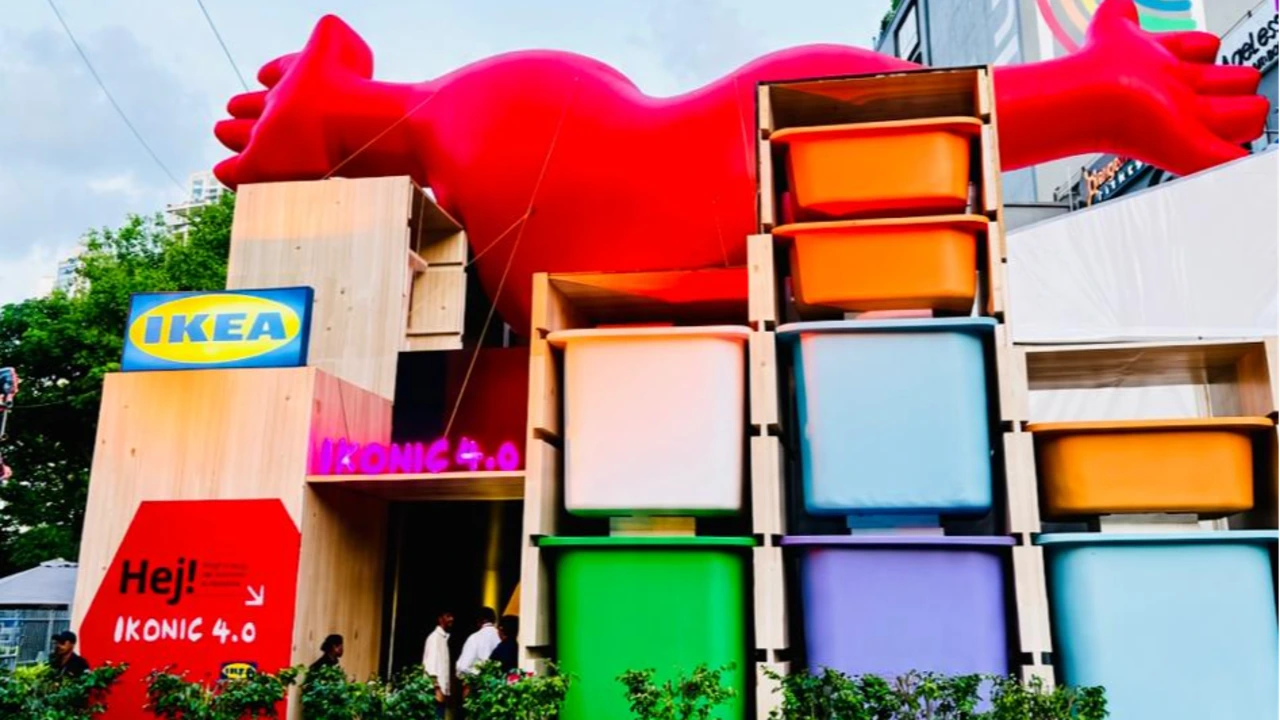
Ikea India's Ikonic 4.0 held in Mumbai at the brand's Worli store.
Manifest spoke with Nivedeeta Moirangthem, country communication manager, Ikea India, on the sidelines of Ikonic 4.0, held at the brand’s store in Worli, Mumbai.
From an event to a brand platform
Ikea has opened Ikonic to a wider mix of audiences, and Moirangthem is clear that the property cannot exist in isolation from the brand’s larger agenda.
“We want to enhance our conversations with our audiences around the home,” she expressed. “Home is a place where you eat, you do everything, you sleep, you relax, you socialise, you think, you reflect, you are your own person.”
This year’s focus on organising is framed through the idea of making space for what people love. For Moirangthem, that is both a physical and emotional proposition.
“If you organise well, you make space for things that you really want to have, or you really want to own, what you love,” she added. “The home is a reflection of you. So it's a conversation around that.”
Ikonic's broader audience is part of that effort. Customers sit alongside people who may not yet buy from Ikea, as well as creators, thought leaders, design students and others within the wider ecosystem.
“It is a big leap that we have taken from the earlier years to be able to interact with more people and establish a position for Ikea as a brand that has a lot of insights about the home,” she shared, adding the caveat: “Not everything yet, but a lot about the home, and will continue to learn going forward.”
That qualification is telling. Rather than claiming ownership of the entire home conversation, Ikea is positioning itself as a brand still learning from it.
Making the store part of the experience
Held on 26th and 27th September, this was the first edition of Ikonic that was held inside an Ikea, a move that Moirangthem sees as part of a larger shift in how the company thinks about its retail spaces.
“We look at Ikonic as a longer-term brand positioning platform,” she stated. “It’s part of our larger marketing and communication effort. It’s not a one-off that we’ll look at.”
The ambition extends beyond Ikonic. “We want to establish the store as the epicentre of all experiential things that we do,” she expressed.
That means the store is expected to perform several jobs at once: retail destination, showroom and a place where consumers can encounter the brand through experiences and events.
“With the store, we see it as an epicentre for visitation, for buying, but also for experiencing different things,” Moirangthem shared.
It is a notable evolution for a retailer whose physical stores have traditionally been destinations in their own right. Ikea currently has stores and customer meeting points across markets including Hyderabad, Mumbai, Bengaluru, Delhi and Pune, alongside its online presence. Its Pune city store, for instance, opened in March 2026 as a 32,000 sq ft format designed around urban homes.
India’s idea of home is anything but singular
The challenge, however, is that there is no single Indian home for Ikea to design or communicate around.
Moirangthem points to Mumbai as an obvious example. The city’s smaller homes and demanding commutes create a stronger need for products and layouts that can perform multiple functions.
“We've learned that you have to work with creativity, innovation, and multifunctionality,” she shared.
A day bed might become a bed, a sofa might serve several members of the family, while extendable tables and foldable furniture can be brought out when guests arrive.
“It’s a lot about practicality, and also people don’t have time,” she said, sharing about Mumbai. “You have to travel such long distances to work and to school and to college.”
The requirements shift elsewhere. “In Bengaluru and Delhi, for example, we have bigger balconies, bigger homes,” she remarked, creating opportunities to think about spaces for different activities.
Her broader point is that these distinctions cannot simply be reduced to product requirements.
“Different regions have different cultures,” she added. “Life-at-home insights are the basis for everything that Ikea does.”
That localisation is increasingly important for a brand trying to establish a stronger position in a market where the meaning and function of home can change significantly from one city to another.
A more deliberate creator strategy
Creators form another part of the equation, but Ikea’s approach appears to be moving away from simply attaching well-known names to campaigns.
The starting point, according to Moirangthem, is relevance.
“The first criterion is that they need to be interested in the home or home furnishings, or design,” she said. Food, creativity and sustainability are also areas the brand looks at.
More interestingly, Ikea is looking at creators who may not yet have significant scale.
“We are exploring maybe, say, influencers and creators from other parts of India who we see as potential home furnishing influencers of the future,” she shared.
She pointed to the UK as an example of the longer-term approach Ikea would like to replicate, where a creator who began working with the brand at a much smaller scale eventually became a major voice in the home and design space.
“But for us, it’s a lot of trials and tests now with a more structured influencer strategy,” she stated.
According to Moirangthem, Ikea worked with around 600 influencers last year and is looking to almost double that number in the coming year.
The scale matters, but the more significant shift is in how the brand thinks about the creator relationship: less as a campaign transaction and more as a potential long-term association.
The harder test is whether the brand sticks
The new positioning is still relatively young. Ikea announced ‘It All Starts at Home’ in February, describing it as a strategic shift in how it would connect with Indian consumers.
Moirangthem said the brand is deliberately resisting the expectation of an immediate verdict.
“It takes time to build the brand,” she added. “We are eight, nine months into the journey. We are making a consistent effort to build this new position.”
That effort has included advertising, events and conversations around what home means to people. But she is cautious about attributing every change in brand health directly to communications.
“Brand trust has really improved over the last six, seven months,” she says. “We need to dig deeper to figure out what brand trust means to the many people, what kind of questions, what kind of responses come in.”
For her, the distinction matters because a brand is built through more than advertising.
“It’s not only the communication and marketing part,” she added. “It’s also the overall offer that you have from the store, services, everything.”
That makes the next phase more difficult to measure, and arguably more consequential.
This also goes to show that a campaign can create attention quickly. Building a brand people return to requires something that lasts beyond the campaign window.
From transactions to advocacy
Moirangthem does not dismiss the commercial metrics. When asked about what metrics Ikea is looking into when it comes to the Indian market. She said, “More sales, more visitation. Of course. I mean, that is the goal of any business.
However, Moirangthem believes the longer-term measure is what happens after the purchase.
“We don't want to lose the customer,” she remarked. “A Customer may come to us once or twice, but we would like customers visiting again and again. We'd like the customer to bring in more friends, more people. We'd like the customer to speak well of Ikea, and be the brand ambassador.”
That is where Ikea’s current brand-building push ultimately lands: not in another campaign metric, but in whether the brand becomes something consumers voluntarily carry into conversations with other people.
For Ikea, the harder question now is not whether people know what it sells. It is whether, after the shopping trip is over, they have a reason to keep talking about it.
“Our ambition is to build a really loved brand. And when one loves someone, they aim to do their best not to leave them, and that is our goal,” Moirangthem concluded.