

 Subscribe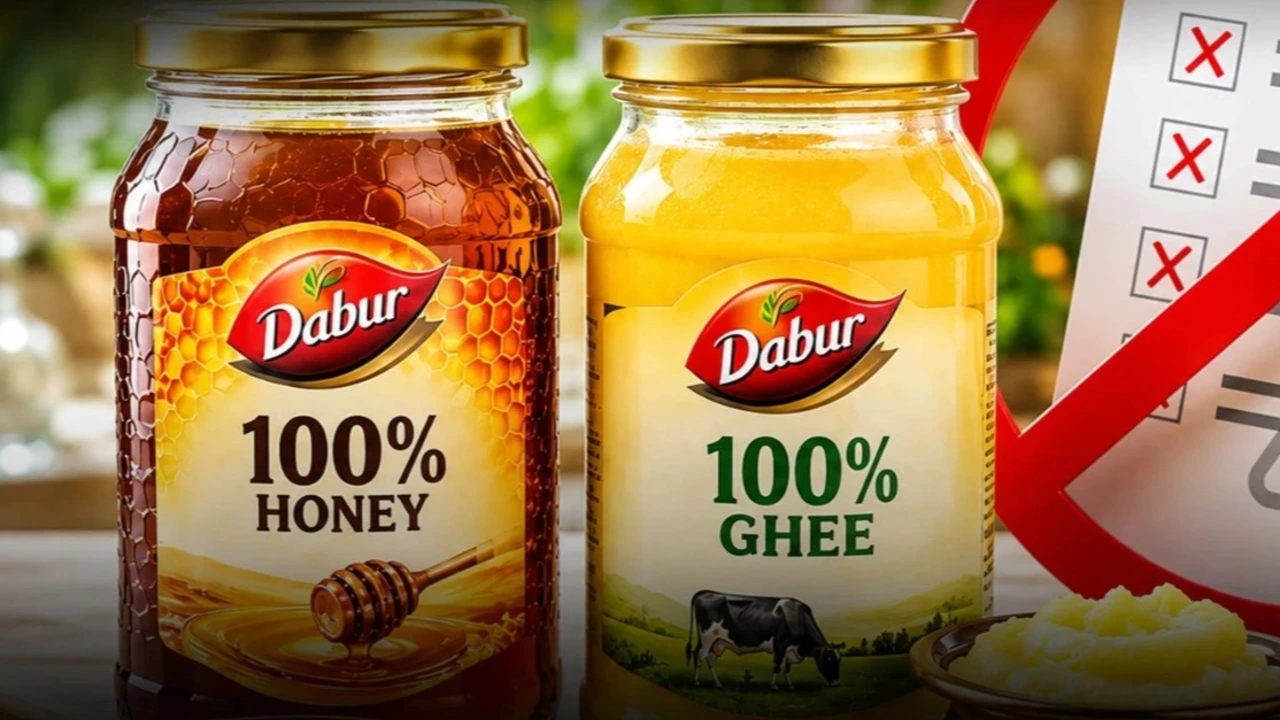
 FSSAI bans Dabur from selling honey, ghee with '100 per cent' claims
In a major clamp down on companies making false and misleading claims, the Food Safety and Standards Authority of India (FSSAI) has issued an order directing FMCG major Dabur India Ltd. to withdraw products carrying ‘misleading 100% claims’.
The food safety regulator has asked Dabur to withdraw products featuring claims such as "100 per cent Natural", "100 per cent Pure", "100 per cent Purity Guaranteed", "100 per cent Organic" and "100 per cent Tender Coconut Water", stating that several critical non-compliances had been observed.
Despite an earlier notice directing discontinuation of misleading “100%” claims, no satisfactory corrective action was taken by the company, the FSSAI noted. The regulator issued notice to the company to withdraw such products from the market with immediate effect and to submit an Action Taken Report (ATR) in 15 days.
FSSAI has issued a Prohibition Order directing M/s Dabur India Limited to immediately cease the sale of food products carrying misleading "100%" claims.#FSSAINotice #FSSAIAction pic.twitter.com/7GdNRUJFyh
— FSSAI (@fssaiindia) August 3, 2026
According to FSSAI, such claims are not permitted under the Food Safety and Standards (Advertising and Claims) Regulations, 2018, as they may mislead consumers and cannot be adequately substantiated.
Among the products flagged are select variants of Dabur honey, ghee and Dabur Hommade Coconut Milk. FSSAI specifically objected to the "100 per cent Purity" claim on the coconut milk, stating that compound food products are not permitted to carry such absolute claims.
Following reports of the action, the company’s shares fell by about 4% to INR 408.25 on the BSE.
Responding to the directive, in a filing with stock exchanges, Dabur India said, “The company believes that the declaration on our product labels comply with the prevailing legal and regulatory framework and are consistent with long-standing industry practices. Dabur stands by the purity and quality of its products and has never made any misleading claims.”
However, it added that the company has already initiated changes across product labels, advertisements and website content to remove the disputed '100 per cent' claims.
“However, as a good corporate citizen, Dabur had already initiated transitioning of the product labels as mentioned in the FSSAI letter to new labels/advertisements without the 100% claim,” it said.
“Most product labels/advertisements/website as mentioned in aforesaid order, have either already transitioned or are in the process of transition. The company is responding accordingly to FSSAI and will continue to engage constructively with them to resolve the matter,” it added.
The company said it was exploring options in relation to the prohibitory order.
The development comes amid a wider regulatory focus on misleading food marketing claims in India.
In a widely viewed podcast released in August 2026 with food influencer Food Pharmer (Revant Himatsingka), Maharashtra Food and Drug Administration Commissioner Tukaram Mundhe said misleading food advertising and marketing claims are illegal and punishable under law.
During the discussion on food adulteration, restaurant hygiene, label transparency and food safety, Mundhe said legal liability does not rest solely with manufacturers making misleading claims. He added that individuals who promote or endorse such claims, including actors, celebrities and other public figures communicating them through spoken or written words, can also be held accountable under the law.
The developments underscore regulators' increasing focus on food labelling, advertising and endorsement practices, with authorities signalling stricter enforcement against claims that could mislead consumers. Mundhe's broader enforcement drive has focused on issues including unhygienic eateries, synthetic milk and analogue food products.