
 Subscribe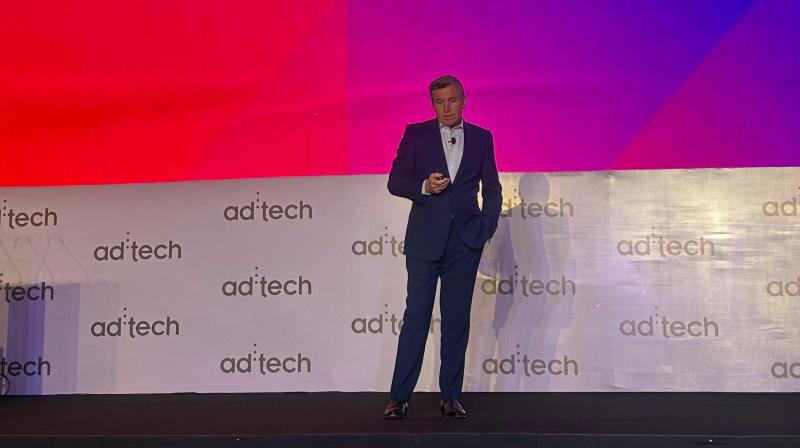
 Jamie Jouning
The first session of ad:tech 2026 set the tone for what its theme for this year, 'The Bold Front' really means.
Kicking off the summit, Jamie Jouning, global head - advertising, The Economist, took the stage to map the forces reshaping marketing and the world around it.
His session wasn’t just about AI hype. It was about uncertainty, uneven progress, and why the next era of marketing will be defined less by campaigns and more by how well organisations design systems.
Jouning started with a sweeping view of a world in flux and a marketing industry on the edge of structural change.
“Over the next few minutes, I want to draw on the breadth of expertise we have at The Economist, from editorial to economic forecasting, to unpack what’s happening in the world and what that means for marketing,” he said. “Because the context in which we operate is changing faster than most of us are comfortable admitting.”
A world defined by instability, not predictability
Jouning began by grounding the conversation in geopolitics and macroeconomics, pulling from The World Ahead - The Economist’s long-running forecast of global trends.
“What we’re seeing now is not a stable geopolitical order with clear rules,” he said. “It’s a far more fragmented, transactional environment, where decisions are increasingly driven by short-term instinct rather than long-term alignment.”
Referencing global tensions and shifting alliances, he added, “The answer to whether we’re heading towards war or peace is probably both. We’re in a moment where fragile stability exists alongside escalating risk.”
For Europe, the balancing act is especially stark.
“Europe is being asked to increase defence spending, sustain economic growth, manage deficits and remain politically stable - all at the same time,” he said. “The reality is, it cannot do all of these things simultaneously without trade-offs.”
At the same time, he pointed to China’s strategic positioning.
“In a world where US policy is becoming more unpredictable, China has an opportunity to present itself as a more reliable, transactional partner, particularly across the 'global south',” he noted.
AI’s rise is real, but it’s uneven and messy
From macro shifts, Jouning moved into AI, framing it not as a clean revolution, but a complex, uneven acceleration.
“There’s a tendency to talk about AI as if it’s moving at the same speed everywhere,” he said. “But the reality is far more nuanced. AI is accelerating, but it is not accelerating evenly.”
He broke it down clearly:
“Usage is growing rapidly. More people, more markets, more industries are engaging with generative AI. But adoption is uneven, investment is surging, and return on investment is still uncertain.”
And that combination changes the rules.
“When those conditions exist together, success doesn’t come from moving fastest,” he said. “It comes from designing better systems than your competitors.”
He stressed that adoption is not just a tech issue.
“AI adoption is not fundamentally about access to technology,” he explained. “It’s about behaviour, incentives and whether organisations are actually ready to integrate it into how they work.”
The growing divide in AI adoption
One of the sharper insights from his session was the widening global gap.
“What we’re seeing is a clear divide between the global north and the global south in terms of both AI capability and adoption,” he said. “And that gap is not narrowing, it’s widening.”
For marketers, this creates a new layer of complexity.
“The future of AI-enabled customer experiences will not scale evenly,” he said. “Different markets will move at very different speeds, which means your strategies cannot be uniform.”
Big money, unclear returns
While adoption remains uneven, investment is anything but cautious.
“There is enormous capital flowing into AI right now,” Jouning said. “But that doesn’t mean organisations are seeing consistent productivity gains yet.”
Inside companies, the reality is even more fragmented.
“Employees are already using AI tools every day for writing, research, coding, analysis,” he said. “But in many cases, this is happening outside formal systems and processes.”
That gap between usage and integration is where the real challenge lies.
“Real value will only emerge when AI is embedded into workflows,” he added. “And that requires redesigning how organisations actually operate.”
Marketing’s shift: From campaigns to system design
This is where Jouning’s argument sharpened.
“For decades, marketing advantage was about channel mastery, who could buy media better, target more precisely, optimise more effectively,” he said. “That model is now being disrupted.”
In its place, a new kind of advantage is emerging.
“In an AI-mediated environment, advantage shifts towards trust infrastructure, governance systems and how well you design for machine-led decision-making,” he shared. “Marketing becomes less about campaigns and more about system design.”
The rise of agentic commerce
He pointed to agentic commerce as a clear signal of where things are headed.
“We’re moving into a world where AI agents can research products, compare options and complete transactions on behalf of consumers,” he stated. “And that fundamentally changes how discovery works.”
The implication for marketers is significant.
“You are no longer optimising purely for human attention,” he explained. “You are increasingly optimising for how machines evaluate, interpret and recommend your brand.”
That shift is already visible in search behaviour.
“Success is no longer just about ranking on a search engine,” he said. “It’s about being cited, being trusted and being understood by AI systems.”
Regulation, sustainability and infrastructure take centre stage
Beyond marketing, Jouning highlighted three forces that will shape AI’s trajectory: regulation, sustainability and infrastructure.
“Regulation is evolving quickly, and it’s not consistent across regions,” he said. “That makes governance a strategic issue, not just a legal one.”
On sustainability, he was direct.
“The environmental cost of AI is becoming impossible to ignore,” he said. “Energy consumption and sustainability targets will increasingly influence how and where AI is deployed.”
And underneath it all is infrastructure.
“We often talk about AI in terms of algorithms,” he said. “But the reality is, it depends on power, compute and resilient systems. Without that, none of this scales.”
Early gains are visible, but barriers remain
Despite the complexity, AI is already delivering results.
“Marketers who are using AI are seeing tangible improvements, whether that’s in ROI, customer satisfaction, conversion rates or cost efficiency,” he said.
Top-performing teams are pulling ahead quickly.
“They are significantly more likely to be using AI agents and integrating them into workflows,” he noted. “That’s where the performance gap is starting to emerge.”
But the transition is far from frictionless.
“There are still real barriers, lack of expertise, governance challenges and uncertainty around where AI delivers the most value,” he said.
Closing the session, Jouning returned to his core thesis. “We’re in a moment where AI is accelerating, but unevenly. Investment is rising, but returns are still uncertain,” he said.
And in that environment, the definition of marketing success is changing.
“Marketing advantage is shifting from buying attention to designing decision systems,” he concluded. “The organisations that will succeed will not just adopt AI, they will architect it.”