

 Subscribe
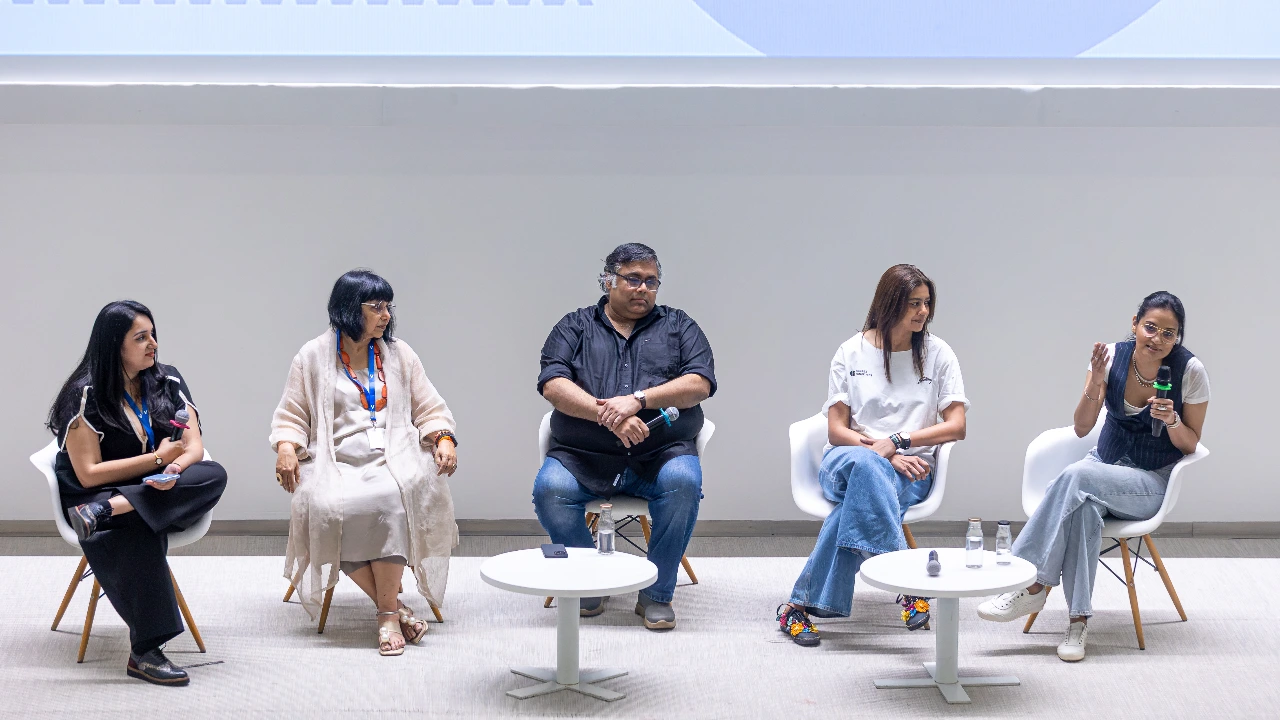
 From left: Shreya Arora, Preeti Vyas, Harshad Rajadhyaksha, Darshan Gandhi and Rajeshwari Rao
At the second Indian edition of Cannes Lions International Festival of Creativity's 'See It Be It Connects', organised by Indian Creative Women and Manifest in partnership with Godrej Industries on 19 November, creative leaders discussed the gap between creative execution and business communication, highlighting the need for designers to take greater ownership of their ideas and articulate their value to clients. Partners for the event included Adfactors PR, First December Films, Kulfi Collective, and Chrome Pictures.
Titled ‘Art and ambition’, the panel featured Darshan Gandhi, global head – design, Godrej Consumer Products, and group head – Disco, Godrej Industries Group; Harshad Rajadhyaksha, chief creative officer, Ogilvy; Preeti Vyas, chairperson, founder, Vyas Giannetti Creative; and Rajeshwari Rao, national creative director, Schbang.
The session was moderated by Shreya Arora, senior creative director, Ogilvy.
The discussion examined the traditional divide between art and copy, the importance of understanding business objectives, and how creative professionals can build the confidence to defend and sell their work.
On bridging the gap between creative craft and business communication
Gandhi said creative professionals are trained to make presentations and explain their design process, but often struggle to communicate their thinking to audiences outside the creative industry.
“Craft is one thing that gets you into the room, but the narrative is what gets you buy-in from the people who need to understand it. Craft exists for a reason, and that reason has to matter,” she voiced.
She added that creative professionals need to understand two audiences: the end consumer and the people who can help them reach that consumer.
Building context and preparing to explain creative decisions can help ideas gain support rather than fall through because their rationale has not been communicated effectively.
On challenging the traditional art and copy hierarchy
Rajadhyaksha recalled beginning his advertising career in an environment where the idea was considered supreme, irrespective of who created it.
However, he later encountered agency structures where art directors received briefs that had already been developed by senior copywriters, leaving them with little involvement in the thinking behind the work.
He said this also meant art professionals often missed opportunities to participate in client meetings and explain their creative decisions.
Rao expressed that writers traditionally ended up presenting ideas because they were the ones who had developed them, leaving designers in the background. She urged art directors and designers to speak for their work rather than assume the finished output would communicate its value.
“Yes, you will specialise in a certain discipline, and that's important. That's what you love, and that's what you will do. But also have a voice in the room,” she advised.
Rao also encouraged designers to develop their writing and communication skills. “As I say, I identify as a communications professional, not just art or copy,” she said.
On understanding the business behind design
Vyas drew on her experience at the National Institute of Design and in advertising to argue that creative professionals should not restrict themselves to individual disciplines. She said design needs to be understood as part of a larger business ecosystem, rather than simply for its aesthetic value.
Recalling how she taught herself the language of business, Vyas said, “That's when I realised that design is actually economics. It's a management tool, and I must speak that language.”
She described this approach as 'designomics', explaining that clients approach designers to solve business problems through design, not merely to create visually appealing work.
Vyas also urged creatives to understand technology, business environments and changing consumer segments, rather than relying on broad generational labels. She encouraged them to present their own work and learn to communicate with management in terms of business outcomes.
On selling creative ideas and navigating client feedback
Rao said clients should not be viewed as people trying to compromise creative work. They have businesses, revenue targets and products to sell, and may not always be familiar with design language.
“We are not in the field of fine art. Yes, we are in the field of making things beautiful, pretty, aesthetic and appealing. But we also have consumers who need to absorb that communication,” she expressed. “We are in the field of commercial art.”
She encouraged designers to probe client feedback, understand the reasoning behind it and find common ground between creative intent and business requirements.
Vyas stated that selling an idea begins well before the presentation.
Creative professionals must understand the client, read between the lines of a brief and structure presentations in a way that builds a sense of ownership among stakeholders, according to her.
“Fifty per cent of your job is done even before you've shown the work,” Vyas shared, adding that research, relevant references and a clear explanation of the intended impact can strengthen the case for an idea.
Rajadhyaksha illustrated the importance of storytelling through an example of facial tissue packaging. The understated, textured design was intended to make consumers perceive the tissue inside as softer. He said the idea could have been rejected if presented alongside more visually appealing alternatives without explaining the thinking behind it.
“If you don't tell your design story, it's going to die a premature death. So be the voice for your work,” he said.
Gandhi encouraged creatives to believe in their work and find ways to make clients understand its value. “If you believe in it, just figure out a way to make them believe that it's the right thing to do,” he said.
Rao echoed the sentiment, urging young creatives not to shy away from presenting ideas they believe in.
She concluded by offering a piece of advice to young creatives: “Don't be scared to make a fool of yourself while presenting. What's the worst that can happen? The brand will say no. Somebody will laugh at you. It's not the end of the world. You figure out another idea or you have a great story to tell!"
Jack Daniel's Merchandise was the 'Experience Partner' for the event.
Catch updates from See It Be It Connects through the week on Manifest.
Also read:
See It Be It Connects 2026: ‘Ambition is not a personality flaw that needs to be fixed'
See It Be It Connects 2026: 'We're not here to win an election or a popularity contest'