
 Subscribe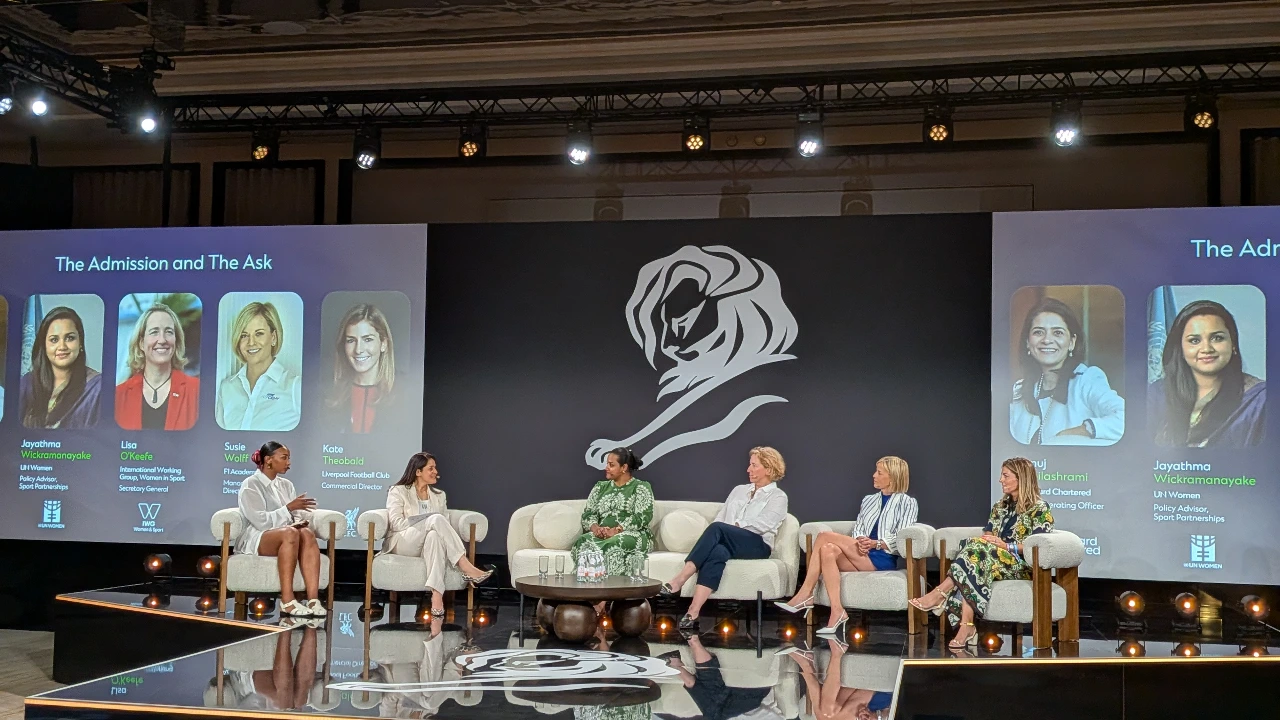
 From left: Naomi Schiff, Tanuj Kapilashrami, Jayathma Wickramanayake, Lisa O'Keefe, Kate Theobald, and Susie Wolff
On day three of the Cannes Lions International Festival of Creativity, a panel featuring Tanuj Kapilashrami, group chief operating officer, Standard Chartered; Jayathma Wickramanayake, policy advisor – sport partnerships, UN Women; Lisa O’Keefe, secretary general, International Working Group on Women and Sport; Kate Theobald, commercial director, Liverpool FC; and Susie Wolff, managing director, F1 Academy, explored why do awareness campaigns often fail to create lasting change for women and girls in sport.
The panel, which was part of Lion Sport, was moderated by former racing driver and broadcaster Naomi Schiff.
Kapilashrami opened by stating how research conducted by Standard Chartered across India, Kenya and Vietnam found that girls are twice as likely as boys to drop out of sport by the age of 14.
"We have spoken about this issue for years. It's a global problem, but the reasons for them dropping out matter," she said.
The research uncovered barriers ranging from safety concerns and violence to menstruation and a lack of practical knowledge.
"Young girls take a burden of gender chores. The idea of femininity varies across the world, and that has an impact on young girls playing sport. The benefits of sport are often hidden unless parents have experienced it themselves."
For Kapilashrami, the findings reinforced a lesson many brands are beginning to realise.
"We have created campaigns, but they can't help drive real systems change. Systems can change only through collaborations. It's about sports clubs, government organisations, media and NGOs coming together."
She pointed to Standard Chartered's work with Liverpool FC's ‘Play On’ programme and its involvement with F1 Academy as examples of partnerships designed to remove structural barriers rather than simply generate visibility.
"It's more than partnerships and campaigns. We want to remove barriers," she said. "With Play On, we have run recruitment fairs at Anfield with the women's team. When you start thinking about real barriers and the role a bank can play to address these issues, that's when real change happens."
The conversation repeatedly returned to a central theme: girls are not choosing to leave sport.
Schiff observed, "Girls drop out of sport twice as much as boys by the age of 14. It's not because girls aren't resilient enough. It's whether systems want them to be there or not."
Wickramanayake acknowledged that even organisations working to advance gender equality sometimes begin with the wrong assumptions.
"What the UN is doing wrong is that we try assuming what's best for girls without directly asking them what matters," she said. "Girls do not want to leave sport at 14. They are pushed to leave sport."
She explained that keeping girls involved in sport often has ripple effects across education, health and economic participation.
"If girls like playing sports, they might stay in school. That can help delay marriage and having children later. It's about removing barriers."
She stressed that governments and international organisations cannot achieve this alone.
"We have to work with brands and athletes to keep girls in sport longer."
For O'Keefe, who spent 14 years playing international rugby before helping lead the celebrated This Girl Can campaign, the biggest lesson was that awareness is only the starting point.
"Research told us about the fear of judgment. I thought naively that if we created a campaign around it, we would get over it. The research told me that I had to fix the system."
She urged brands and policymakers to recognise that participation decisions are influenced by wider cultural forces.
"We don't live in a vacuum. We are shaped by the world around us. Policy makers, brands and institutions all have the ability to influence culture. It takes time, resources, and it can be frustrating. But if we do it, we can deliver for the many, not the few," she said.
The challenge looks different in every sport.
For Wolff, motorsport's biggest issue remains participation. While men and women compete together, the latter account for only around five per cent of competitors.
"It's a numbers game," she said. "We have to change the perception."
The barriers are often practical rather than promotional.
"Drivers wear helmets, so nobody sees whether it's a boy or a girl. Young children can't drive themselves to race tracks. They need someone to take them. They need the ecosystem."
That ecosystem extends to commercial partners.
"We can't underestimate the importance of getting a brand on board because the financial barrier is so much in Formula 1," she said.
Pointing to a growing female fan base, she added, "We have a female fan base, but we can't tell them it's a male-dominated sport. We need to reach out to young girls, too."
Theobald argued that women's sport is experiencing a breakthrough moment, but warned against short-term thinking.
"It's an amazing moment for women's sport. It's hot right now in the most beautiful way," she said.
Yet the industry's challenge remains balancing investment with growth.
"It's the chicken-and-egg question. Do dollars get invested first, or do we wait for the growth?"
For Liverpool FC, the answer lies in long-term partnerships.
"We have amazing partners, but we want long-term commitments for the sport. We have to write stories together," she said, citing Standard Chartered alongside partners such as Google Pixel and Accenture.
"We can't be here for a year and win a bunch of awards. It has to be sustainable."
Wickramanayake echoed that sentiment.
"To change the lives of women for good, we need to change stereotypes by dismantling systems. When a multi-year commitment is made, one needs to back those decisions and stay with them even when things go wrong."
Kapilashrami concluded with one more point from research. It showed that 80% of female Fortune 500 CEOs played sports earlier in life.