

 Subscribe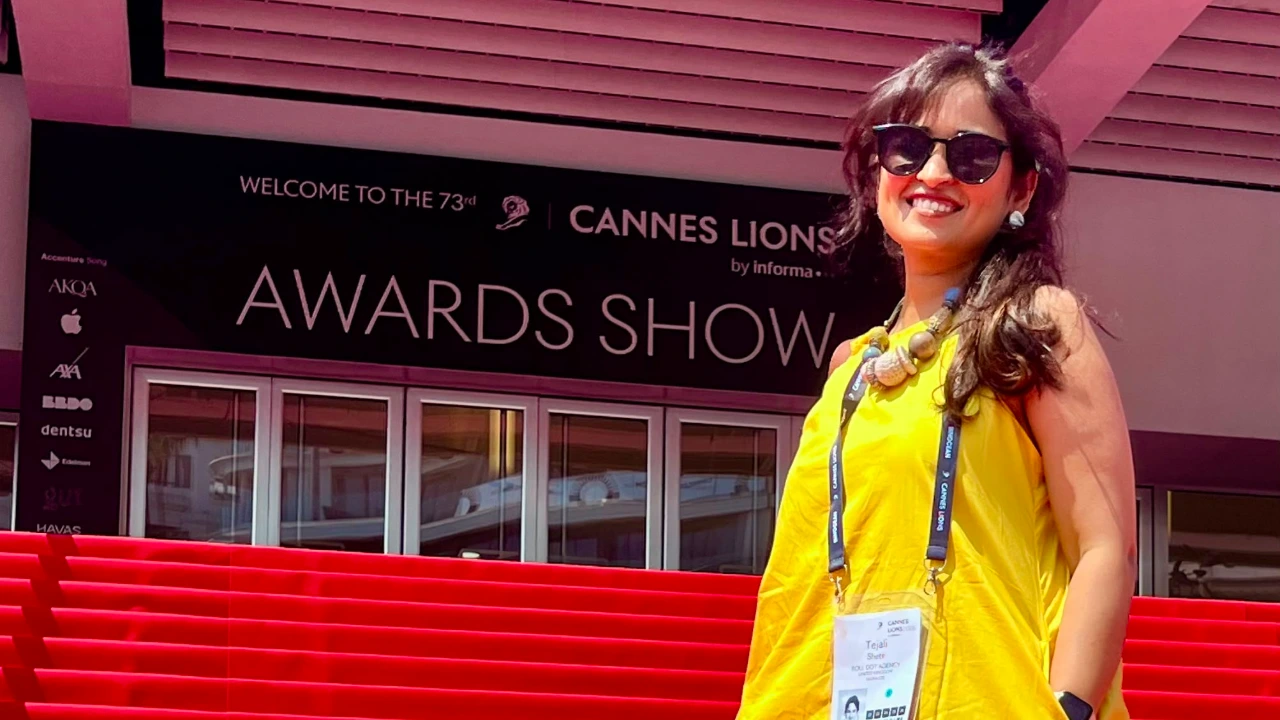
 Tejali Shete
I wasn't in the jury room in Cannes this year. I was something arguably harder, a shortlist juror for the Outdoor Lions, reviewing entries online, alone, before the festival even began.
No room energy, no peer debate. Just you and the work.
1,410 outdoor entries this year and the results made the truth sharper than ever. The work that survived wasn't the most produced or the most expensive. It was the work that was immediately, unmistakably felt, ideas that didn't need context to land. If a piece of outdoor work needs to be decoded, it has already lost.
The Grand Prix said it all. Mercado Livre secured the naming rights to São Paulo's Pacaembu Stadium and instead of putting up a logo, mowed the football pitch into a 104-metre scannable barcode, unlocking a 25% discount for anyone who scanned it, from the stands, from a broadcast, from a screenshot. 53,000 coupon redemptions. USD 1.7 million in sales. AI-powered pattern recognition made it work from any angle, any distance. But AI wasn't the idea, it was the enabler. The idea was a brand truth married to a cultural obsession. That distinction matters enormously right now, when the industry is tempted to let the tool become the thought.
Heinz did what Heinz always does: proved that a brand strong enough doesn't need to show its product. 'Coincidence?' placed the Heinz bottle silhouette against unbranded everyday objects, the idea holding entirely on brand equity alone. De'Longhi built miniature, fully functioning coffee shops in unexpected urban corners, tiny in scale, enormous in stopping power.
What connected all of it was a shift in how the category's best work understood public space. Not as a surface for a message, but as a stage for participation. Heineken's 'Rooftop Revival' turned an overlooked urban space into a brand experience with minimum effort.
These weren't campaigns that happened to be outdoors. They were ideas that could only exist outdoors.
Within this category, the strongest work wasn't using public space as a billboard, it was using it as a stage for participation, behaviour change, and real-time brand-building. And crucially, the bravest ideas also had the strongest business cases. At Cannes 2026, creative and effective were no longer separate conversations. The outdoor jury wasn't choosing between the two. They were refusing to accept one without the other.
Which is exactly the conversation India needs to have. 24 shortlists at Cannes Lions 2026. Five metals. Strong performances in craft and health categories, but may have some gaps elsewhere. I say this not as criticism but as someone who has watched Indian creativity from the inside and the outside, we have the cultural depth, the storytelling tradition, and the talent. What we need is the courage to back sharp ideas and the rigour to make sure that idea has a business result attached to it, not as an afterthought, but as the brief.
As the founder of a creative agency operating across Europe and Asia, I evaluate creative work through two lenses simultaneously cultural resonance and commercial logic. I'm building my practice on one belief: a great idea must travel across cultures without losing its soul. Field Barcode was Brazilian to its bones and yet, sitting in London reviewing it on a screen, I felt it in seconds. That's not a cultural insight. That's a reminder that the best ideas were never complicated to begin with.
The author is founder and CCO, Roll Dot Agency (UK and India).