

 Subscribe
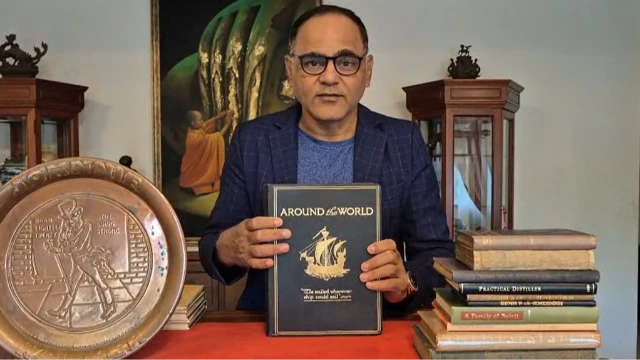
 Samir Dixit with the 1920 Around The World Book
Whisky is routinely classified as a fast-moving consumer good. The logic appears straightforward: it is manufactured, packaged, branded, distributed through retail channels and ultimately consumed.
But classification is not strategy.
Whisky businesses undeniably need FMCG capabilities. Forecasting, supply-chain management, distribution, consumer research, revenue management, retail execution and marketing accountability have helped build some of the world’s most successful whisky brands.
The issue is not the capability. It is what happens when the logic used to distribute whisky becomes the logic used to define, market and measure it.
Most fast-moving categories are built around frequency, replenishment and rapid stock rotation. Toothpaste, detergent, snacks and household products are consumed relatively quickly and replaced predictably. Their commercial models depend on scale, convenience, availability and habitual repurchase.
Whisky behaves differently.
Its production can take years or decades. Its purchase is irregular. A bottle may remain in a home for months or years. Some are opened only on significant occasions; others are gifted, collected or preserved.
Whisky is rarely bought simply because the previous bottle has run out. It may be purchased to celebrate a promotion, commemorate a wedding, thank a client, remember a journey, host friends or begin a collection.
Consumers may choose it because of a distillery, age statement, place, cask, story or trusted recommendation.
That is why whisky is better understood as a consumer packaged cultural good—CPCG.
The word cultural is the critical distinction. A packaged good derives value largely from what is manufactured, contained and distributed. A packaged cultural good derives value from the physical product and from the histories, rituals, communities, identities and meanings surrounding it.
|
Dimension |
FMCG logic |
CPCG logic |
|
Source of value |
Function, convenience and availability |
Product quality plus cultural meaning |
|
Purchase behaviour |
Frequent and repeatable |
Episodic, considered and occasion-led |
|
Role of time |
Usually a cost |
A production input and value creator |
|
Role of place |
Often secondary |
Central to provenance and authenticity |
|
Consumer motivation |
Need, habit or immediate desire |
Discovery, gifting, ritual and participation |
|
Growth mechanism |
Penetration, frequency and conversion |
Meaning, occasion, advocacy and willingness to pay |
Whisky moves through commerce, but it acquires value through culture.
That culture can be found in landscapes, regulations, grain, water, stills, casks, maturation, tasting rituals, gifting traditions, collectors, bartenders, educators and distillery visitors.
These are not decorative layers added by advertising. They help explain why consumers choose one bottle over another and why they may pay more for it.
Distribution was always necessary—but it was never the entire proposition
The history of Johnnie Walker demonstrates that commercial scale and cultural value are not opposing ideas.
When Alexander Walker inherited the family business in 1857, he recognised the possibilities created by the railway, international shipping and Britain’s expanding trade networks. After launching the company’s first commercial blend in the 1860s, he engaged ships’ captains and trading partners to carry Walker whisky to overseas markets.
This was sophisticated distribution thinking long before the modern language of FMCG existed.
The square bottle also served a practical commercial purpose: it packed more efficiently and was less vulnerable to breakage in transit. The slanted label helped it remain distinctive when it reached distant shelves.
The strategy combined availability with recognisability.
By 1920, Johnnie Walker was available in more than 120 markets. The company marked the scale of this network through its Around the World book, an early travelogue featuring the markets in which its whisky was sold and acknowledging the agents who helped establish the global business.
The philosophy is often captured in the idea that the brand would go wherever ships would sail.
Yet the sales proposition was never merely that Johnnie Walker could be found everywhere.
Its global reach was supported by a consistent emphasis on quality. In 1887, Alexander Walker declared the company’s determination to make whisky of such a standard that nothing in the market would come before it. Later communications continued to combine availability with maturation, experience, quality and the heritage of the Walker name.
That distinction is vital.
Distribution made the brand accessible. Quality, heritage, identity and cultural meaning made it desirable.
Alexander Walker understood the value of what we would now call FMCG-scale distribution. But he did not confuse the route to market with the reason to buy
This is not an argument for less distribution. Distribution is critical. Without physical availability, even the most meaningful brand remains commercially irrelevant.
The question is what distribution is being asked to do.
Distribution can create access. It cannot, by itself, create distinction, loyalty or willingness to pay.
Where the conflict begins
The difficulty begins when a category created through patience is managed primarily through speed.
Spirit matures slowly. Reputation develops slowly. Knowledge is acquired slowly. Trust is built slowly. Cultural meaning accumulates slowly.
Yet commercial systems often reward faster rotation, more promotions, more variants, shorter campaigns, immediate conversion and quarterly volume. None is inherently wrong. The problem is dominance.
|
Commercial action |
Immediate benefit |
Potential long-term cost |
|
Frequent discounting |
Short-term volume |
Consumers learn to wait for promotions |
|
Rapid distribution |
Greater availability |
Weaker context and presentation |
|
Constant releases |
News and listings |
Confusion and weaker core-brand memory |
|
Trade incentives |
Faster movement |
Movement mistaken for genuine demand |
|
Short campaigns |
Visible activity |
Too little time for meaning to accumulate |
An 18-year-old whisky may take nearly two decades to create, yet be judged primarily on whether it delivered this quarter’s target. A brand may spend generations building pricing power, then repeatedly discount itself to stimulate weekly conversion.
Trade execution remains indispensable. Whisky needs distributors, retailers, bars, restaurants and travel retail. But trade movement is not the same as consumer demand.
Listings, displays, rebates and promotions can move stock without creating strong preference. Consumer pull exists when people ask for a brand by name, search for it, recommend it, buy it without a discount, attend a tasting or visit the distillery.
Whisky needs both push and pull. But sustainable value depends on pull eventually becoming stronger.
Whisky should not grow like toothpaste
Many FMCG categories grow by encouraging more frequent purchase and habitual replenishment. That logic is unsuitable as the primary model for whisky. Responsible growth cannot depend mainly on persuading people to consume alcohol more often.
The better opportunity is to create richer occasions: gifting, hospitality, food pairing, travel, celebrations, cultural events, education, collecting and shared experiences.
A consumer who buys two carefully chosen bottles at full price, attends tastings and recommends the brand may be more valuable than someone who buys six discounted bottles interchangeably. The first represents loyalty, advocacy, pricing power and cultural engagement; the second may represent temporary volume.
Whisky also competes before the shelf. Visibility matters, but the strongest brand is often the one the consumer was already seeking. That preference may have been created by a bartender, tasting, journey, recommendation, documentary, dinner or gift.
FMCG seeks to win the shelf. CPCG must first win a place in the consumer’s mind, memory and culture.
Depth, not clutter
Whisky has always innovated through production, blending, maturation, cask use, flavour, formats and experiences.
The problem is not innovation; it is equating innovation with more products.
A new expression is valuable when it creates a credible occasion, advances the product or deepens the brand. It becomes proliferation when it exists mainly to generate news or fill a launch calendar.
When every bottle is limited, limitedness loses meaning.
Accessibility should similarly not mean removing depth. Whisky can appear intimidating, but the answer is to explain its differences clearly and make knowledge enjoyable to acquire.
Accessibility should open the door to whisky culture, not remove the culture behind the door
Heritage must also be treated as more than campaign content. The founders, distilleries, archives, communities and traditions accumulated over generations are cultural capital. They should guide products, innovation, experiences, education, partnerships and intellectual-property stewardship.
The problem is the scorecard, not the leadership
The argument is not that whisky companies should avoid leaders from FMCG backgrounds. Many have built outstanding brands and brought essential discipline to the category.
The deeper issue is how success is defined.
Organisations naturally prioritise measurable outcomes: volume, shipments, distribution, rate of sale, promotional uplift, market share and campaign conversion. These metrics matter, but they do not fully reveal cultural relevance, provenance credibility, authority, willingness to pay, advocacy or long-term desirability.
A brand can move more cases while becoming less meaningful and less capable of sustaining its price.
Commercial measures should therefore be complemented by indicators such as full-price sales, pricing power, brand requests, recommendation, provenance credibility, tasting participation, community engagement, heritage strength and performance when promotional support is reduced.
A CPCG scorecard should measure not only what moved, but what became more meaningful, more valuable and more difficult to replace
FMCG capability remains essential. It should manage operations, distribution, forecasting, retail execution, analytics and financial accountability.
CPCG thinking should lead the areas that determine why the brand matters: cultural meaning, provenance, heritage, ritual, community, experience and long-term desirability.
Whisky is packaged, branded and distributed through consumer channels. But it is not inherently fast-moving. Its production is slow, its purchase irregular, its consumption episodic, its reputation cumulative and its meaning cultural.
Commercial questions will always matter: how much was sold, where, at what price and at what margin?
But a CPCG category must also ask why consumers should care, what makes the whisky worth seeking out, what gives it meaning beyond the liquid and what will protect its value over time.
FMCG describes how whisky is packaged and moved. CPCG explains how whisky creates meaning and value
Alexander Walker understood both sides of this equation more than a century ago. He built a system capable of taking his whisky wherever ships could sail. But what those ships carried was never positioned as an ordinary, interchangeable product. They carried quality, provenance, reputation and a distinct cultural story. Commercial systems should help whisky travel further.
Culture and engagement is what ensures it continues to matter.
The author is a C-suite strategic business growth advisor, an IP & Valuation expert. He is passionate about whisk(e)y as a category and holds a certificate in whisky distillation, is a certified whisky ambassador, founder of The Whisky Tales (@TheWhiskyTales).